78 lines
3.6 KiB
Swift
78 lines
3.6 KiB
Swift
/*:
|
|
> # IMPORTANT: To use **Rx.playground**:
|
|
1. Open **Rx.xcworkspace**.
|
|
1. Build the **RxSwift-OSX** scheme (**Product** → **Build**).
|
|
1. Open **Rx** playground in the **Project navigator**.
|
|
1. Show the Debug Area (**View** → **Debug Area** → **Show Debug Area**).
|
|
----
|
|
[Previous](@previous) - [Table of Contents](Table_of_Contents)
|
|
*/
|
|
import RxSwift
|
|
/*:
|
|
# Transforming Operators
|
|
Operators that transform Next event elements emitted by an `Observable` sequence.
|
|
## `map`
|
|
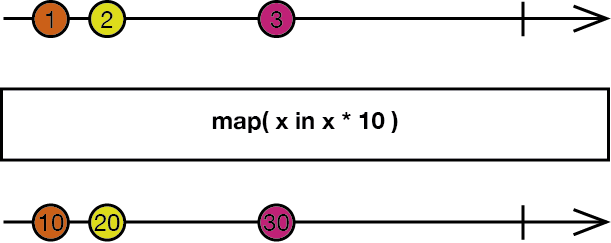
Applies a transforming closure to elements emitted by an `Observable` sequence, and returns a new `Observable` sequence of the transformed elements. [More info](http://reactivex.io/documentation/operators/map.html)
|
|
|
|
*/
|
|
example("map") {
|
|
let disposeBag = DisposeBag()
|
|
Observable.of(1, 2, 3)
|
|
.map { $0 * $0 }
|
|
.subscribe(onNext: { print($0) })
|
|
.addDisposableTo(disposeBag)
|
|
}
|
|
/*:
|
|
----
|
|
## `flatMap` and `flatMapLatest`
|
|
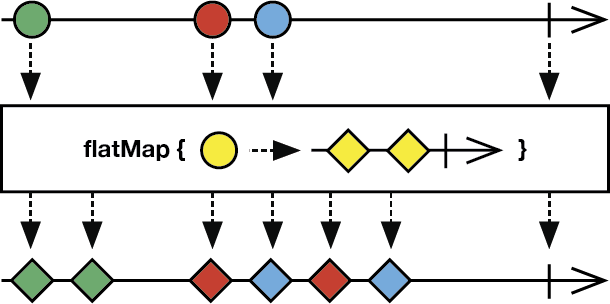
Transforms the elements emitted by an `Observable` sequence into `Observable` sequences, and merges the emissions from both `Observable` sequences into a single `Observable` sequence. This is also useful when, for example, when you have an `Observable` sequence that itself emits `Observable` sequences, and you want to be able to react to new emissions from either `Observable` sequence. The difference between `flatMap` and `flatMapLatest` is, `flatMapLatest` will only emit elements from the most recent inner `Observable` sequence. [More info](http://reactivex.io/documentation/operators/flatmap.html)
|
|
|
|
*/
|
|
example("flatMap and flatMapLatest") {
|
|
let disposeBag = DisposeBag()
|
|
|
|
struct Player {
|
|
var score: Variable<Int>
|
|
}
|
|
|
|
let 👦🏻 = Player(score: Variable(80))
|
|
let 👧🏼 = Player(score: Variable(90))
|
|
|
|
let player = Variable(👦🏻)
|
|
|
|
player.asObservable()
|
|
.flatMap { $0.score.asObservable() } // Change flatMap to flatMapLatest and observe change in printed output
|
|
.subscribe(onNext: { print($0) })
|
|
.addDisposableTo(disposeBag)
|
|
|
|
👦🏻.score.value = 85
|
|
|
|
player.value = 👧🏼
|
|
|
|
👦🏻.score.value = 95 // Will be printed when using flatMap, but will not be printed when using flatMapLatest
|
|
|
|
👧🏼.score.value = 100
|
|
}
|
|
/*:
|
|
> In this example, using `flatMap` may have unintended consequences. After assigning 👧🏼 to `player.value`, `👧🏼.score` will begin to emit elements, but the previous inner `Observable` sequence (`👦🏻.score`) will also still emit elements. By changing `flatMap` to `flatMapLatest`, only the most recent inner `Observable` sequence (`👧🏼.score`) will emit elements, i.e., setting `👦🏻.score.value` to `95` has no effect.
|
|
#
|
|
> `flatMapLatest` is actually a combination of the `map` and `switchLatest` operators.
|
|
*/
|
|
/*:
|
|
----
|
|
## `scan`
|
|
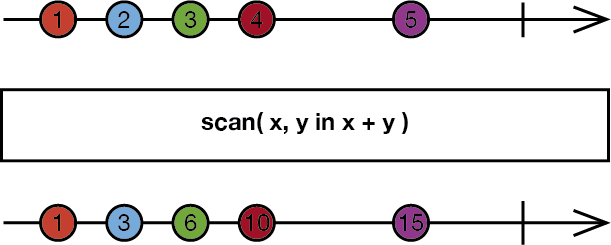
Begins with an initial seed value, and then applies an accumulator closure to each element emitted by an `Observable` sequence, and returns each intermediate result as a single-element `Observable` sequence. [More info](http://reactivex.io/documentation/operators/scan.html)
|
|
|
|
*/
|
|
example("scan") {
|
|
let disposeBag = DisposeBag()
|
|
|
|
Observable.of(10, 100, 1000)
|
|
.scan(1) { aggregateValue, newValue in
|
|
aggregateValue + newValue
|
|
}
|
|
.subscribe(onNext: { print($0) })
|
|
.addDisposableTo(disposeBag)
|
|
}
|
|
|
|
//: [Next](@next) - [Table of Contents](Tabl |